2026 Winter Olympics Women’s Free Skate Results: Alysa Liu Wins Gold as Kaori Sakamoto Takes Silver and Ami Nakai Bronze
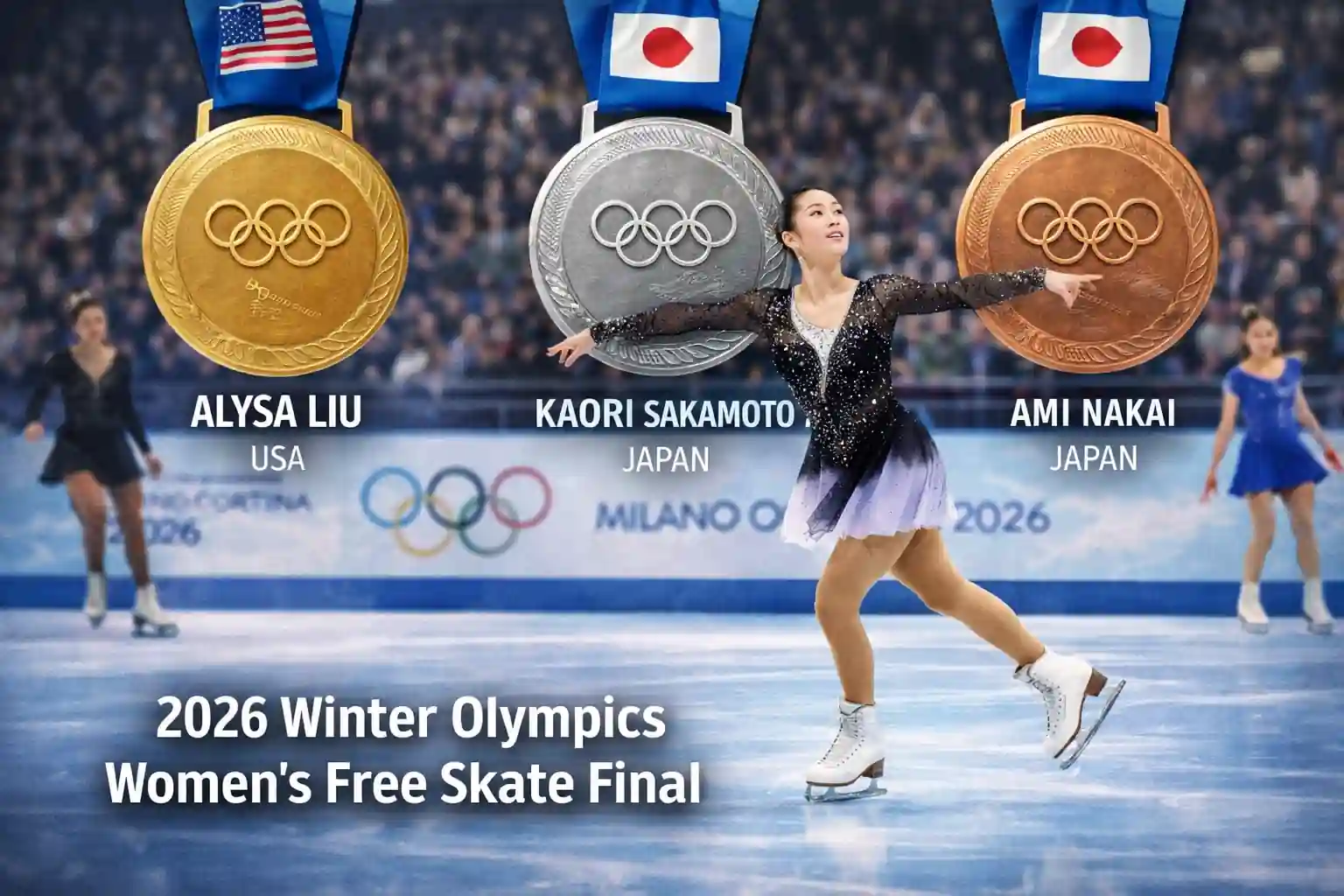

Women’s Figure Skating Olympics 2026: Free Skate Sets the Final Podium
The 2026 Winter Olympics women’s single skating free skating event finalized one of the closest medal races of the Games and closed out the women’s figure skating final with a dramatic last-flight finish. Under the International Skating Union judging system used at the Olympics, women’s figure skating results are determined by combining the short program and the women’s free skate totals, so the free skate is often the decisive segment where standings can shift quickly. That structure mattered in Milano Cortina 2026 because the top of the field entered the final round separated by narrow margins, and a single jump error can translate into multiple lost points once grades of execution and deductions are applied. In practice, the women’s free skate rewards a balance of technical base value and execution quality. Skaters can raise their scoring potential by attempting difficult combinations and maximizing levels on spins and step sequences, but the judging system also penalizes under-rotations, falls, and disrupted flow. For fans searching “womens free skate results” or “olympic figure skating results,” the most important context is that the free skate is the longer program with the most elements and the largest scoring opportunity—meaning it can confirm a leader or create a comeback scenario. Media coverage documented that scenario as it unfolded. Reuters and the Associated Press reported that Alysa Liu’s free skate delivered the winning push, while Japan’s Kaori Sakamoto and Ami Nakai completed the medal podium (Reuters: Liu wins women’s gold in Milan; AP: Liu dazzles to win gold). For verification beyond headlines, the ISU’s Olympic Winter Games results hub and the women’s singles final classification page provide the official placements and point totals used for medal awards (ISU results hub: Olympic Winter Games 2026; ISU final standings: Women Single Skating – Result). For people tracking “figure skating schedule and results” during the Olympics, those primary sources are also the most reliable way to confirm when each segment took place and how the rankings were calculated, especially when broadcast score trackers and social posts circulate partial information.Event format: Short Program + Free Skating totals determine final placement
Primary official source: ISU women’s singles final classification (CAT002RS)
Key media recaps: Reuters and AP reported the medal podium and totals
Alysa Liu Olympics 2026: Gold Medal Performance in the Women’s Free Skate
Alysa Liu captured the Olympic title in women’s figure skating with a free skate that combined high-value technical content and clean execution at the moment it mattered most. Reuters reported that Liu produced a season-best 150.20 in the free skate and finished with 226.79 points overall to win gold (Reuters: season-best free skate and winning total). The ISU’s segment detail page for the free skating round lists Liu’s 150.20 total segment score along with the components that make it up, including her technical element score (TES) and program component score (PCS), which helps explain how the performance separated from the field (ISU free skate details: Women Single Skating – Free Skating). The Associated Press also reported the same 226.79 total while describing Liu’s free skate as near-flawless and framing the win as a milestone for U.S. women’s singles at the Olympics (AP: scoreline and drought context). From an SEO standpoint, searches like “alysa liu free skate,” “alysa liu long program,” and “alysa liu gold medal performance” usually reflect two reader needs: what the official numbers were and where those numbers are documented. The ISU site and Olympics coverage pages answer both by publishing segment-level scoring and overall standings. “How old is Alysa Liu?” is another frequent question tied to major championship moments. Multiple outlets identified Liu as 20 during the 2026 Games and highlighted her path back to the sport after stepping away earlier in her career (AP: age and comeback narrative; The Guardian: Liu’s age and historical significance). Reuters noted her program was skated to Donna Summer and emphasized the crowd response, a detail echoed in broadcast coverage and post-event reporting (Reuters: performance description). For readers comparing “Alysa Liu” versus common misspellings like “Alyssa Liu,” the official competition documents consistently list her as LIU Alysa in the results tables. Those tables—along with the judges’ detailed scoring PDFs—serve as the primary record for the Olympic women’s figure skating results in 2026 (ISU judges details PDF: Judges Details per Skater).Alysa Liu free skate score: 150.20 (season best, per Reuters and ISU)
Alysa Liu total score: 226.79 (gold medal, per Reuters/AP/ISU)
Alysa Liu age at Milano Cortina 2026: 20 (reported by AP/The Guardian)
Women’s Figure Skating Medals: Kaori Sakamoto Silver and Ami Nakai Bronze
Japan placed two skaters on the women’s figure skating medals podium at Milano Cortina 2026, with Kaori Sakamoto taking silver and Ami Nakai earning bronze. Reuters reported Sakamoto’s final total as 224.90—just behind Liu’s 226.79—and Nakai’s as 219.16, completing the top three in overall Olympic women’s figure skating results (Reuters: final podium totals). The ISU’s final classification page for women’s singles also lists those totals and confirms each skater’s short program (SP) rank and free skate (FS) rank, which helps explain how the event unfolded across both segments (ISU overall results: Women Single Skating – Result). One of the notable storylines in the scoring record is that Nakai led after the women’s short program but finished ninth in the free skate segment, meaning her combined total was still enough for bronze due to the strength of her short program cushion and the distribution of errors throughout the field. Reuters described that arc and reported that Nakai faltered in her free skate after leading the short program, while still holding on for a medal (Reuters: Nakai leads SP, takes bronze overall). The ISU short program results page shows Nakai in first after the short program with 78.71 points, ahead of Sakamoto and Liu, which aligns with that reporting (ISU short program details: Women Single Skating – Short Program). Sakamoto’s silver medal also drew significant attention because it marked what Reuters described as her final Olympic appearance, with the report noting her emotional reaction and the narrow margin separating her from gold (Reuters: Sakamoto’s final Olympic skate). For fans searching “kaori sakamoto” and “womens figure skating results,” the key is that her overall total remained within two points of the winner, emphasizing how component marks and execution quality can decide medals when technical content is similar. While your keyword list includes names like Livia Kaiser, the verified official medalists in women’s singles are reflected in the ISU final classification table and confirmed by Reuters and AP. The ISU table also shows other notable placements—such as Mone Chiba in fourth and Amber Glenn in fifth—providing a full answer for searches like “womens figure skating results” and “womens skating results” beyond the top three (ISU: full standings list).Silver: Kaori Sakamoto (224.90 total, per Reuters/ISU)
Bronze: Ami Nakai (219.16 total; led after SP, per Reuters/ISU)
Short program leader: Ami Nakai (78.71 SP, per ISU)
Women’s Free Skate Results Breakdown: What the ISU Protocols Show
For readers who want the most precise view of the women’s free skate results—beyond podium headlines—the ISU scoring pages and protocol documents provide the element-level record used by officials. The free skating segment detail page lists each skater’s total segment score (TSS) and breaks it into technical element score (TES) and program component score (PCS), along with any deductions. In the women’s free skate at Milano Cortina 2026, the ISU’s segment results page shows Alysa Liu leading the free skate with 150.20, followed by Kaori Sakamoto at 147.67, and Amber Glenn at 147.52 in the segment standings (ISU free skate segment: Women Single Skating – Free Skating). That segment ranking is different from the final medal order because Olympic medals are decided by combined totals from both segments. This is a key point for SEO-driven searches like “womens free skate results” and “olympic figure skating results.” It is possible for a skater to place outside the top three in the free skate and still win a medal overall if the short program score was strong enough. That is precisely why the ISU final classification table is the authoritative source for medals, while the segment tables are the authoritative source for how each round was scored (ISU overall: Women Single Skating – Result). The ISU also publishes PDFs that deepen the verification trail. Start lists with times show when each warm-up group and skater was scheduled to compete, which is useful for “womens free skate schedule” queries and for confirming the official time blocks of the event (ISU start list PDF: Start List with Times). Judges’ detail PDFs provide a skater-by-skater breakdown of element calls and component marks, including how each judge scored skating skills, presentation, and composition. Those documents help explain point differences that can appear small in the standings but large in medal impact (ISU judges details: Judges Details per Skater). For the broadest audience, the takeaway is straightforward: if you need the final answer to “who won women’s figure skating medals,” use the ISU final classification table. If you want to understand how the women’s free skate itself was scored—who won the segment, where points came from, and what the panel called—use SEG004 and the supporting PDFs. That is the same data backbone used by teams, commentators, and official Olympic archivists.US Women’s Figure Skating and the Sarah Hughes Search Trend: Why 2026 Matters
Search interest in “sarah hughes skater” and “sarah hughes” often rises when the Olympic women’s singles title becomes a U.S. story, because Hughes’ 2002 gold remains a reference point for American women’s Olympic success. In 2026, reporting by major outlets described Alysa Liu’s win as ending a long drought for the United States in the event. The Associated Press characterized it as a 24-year Olympic drought for U.S. women in the discipline, while Reuters framed the outcome as ending a decades-long gap in American women’s medals at the top of the sport’s Olympic singles event (AP: AP drought framing; Reuters: Reuters context). The Guardian also highlighted the historic angle, describing Liu’s victory as ending a 24-year U.S. drought for Olympic women’s singles gold and noting her age and comeback narrative (The Guardian: historic win profile). From a results perspective, the official record is clear: the ISU final classification shows Liu first overall with 226.79 points, Sakamoto second with 224.90, and Nakai third with 219.16 (ISU: Women Single Skating – Result). Those totals are also why “medal count Olympics 2026” and “gold medal count 2026” appear in search behavior around figure skating finals. A gold medal in a high-profile event can be a major driver of public attention, even for audiences who do not track every discipline on the Winter Olympics schedule. There is also a second layer to the Olympic narrative that mirrors older U.S. women’s singles storylines: the women’s free skate is typically where the title is truly won. In 2026, Liu led the free skating segment with 150.20 according to the ISU segment table, and that free skate result elevated her from third after the short program to first overall, which is visible when you compare the ISU short program ranks with the overall final classification (ISU short program: SEG003; ISU overall: CAT002RS). That is the same structural reason earlier Olympic finals remain memorable: a short program sets the table, and the long program decides the meal. For U.S. figure skating, the 2026 final also underscored depth. While Nakai and Sakamoto represented Japan’s continuing strength, U.S. skaters were also present deeper in the standings, and segment tables show how performance variance across two programs can reshape results. The best way to keep the discussion factual is to use the ISU’s official tables for placements and scores, and to treat media narratives as contextual framing rather than as the scoring authority.More from Dollars & Life
Breaking News:• Latest breaking news
• Global Tensions in Early 2026
Shopping & Lifestyle:
• Best Shopping Deals & Daily Discounts