Global Tensions in Early 2026: From the U.S.–Venezuela Operation to Wider Great-Power Risks
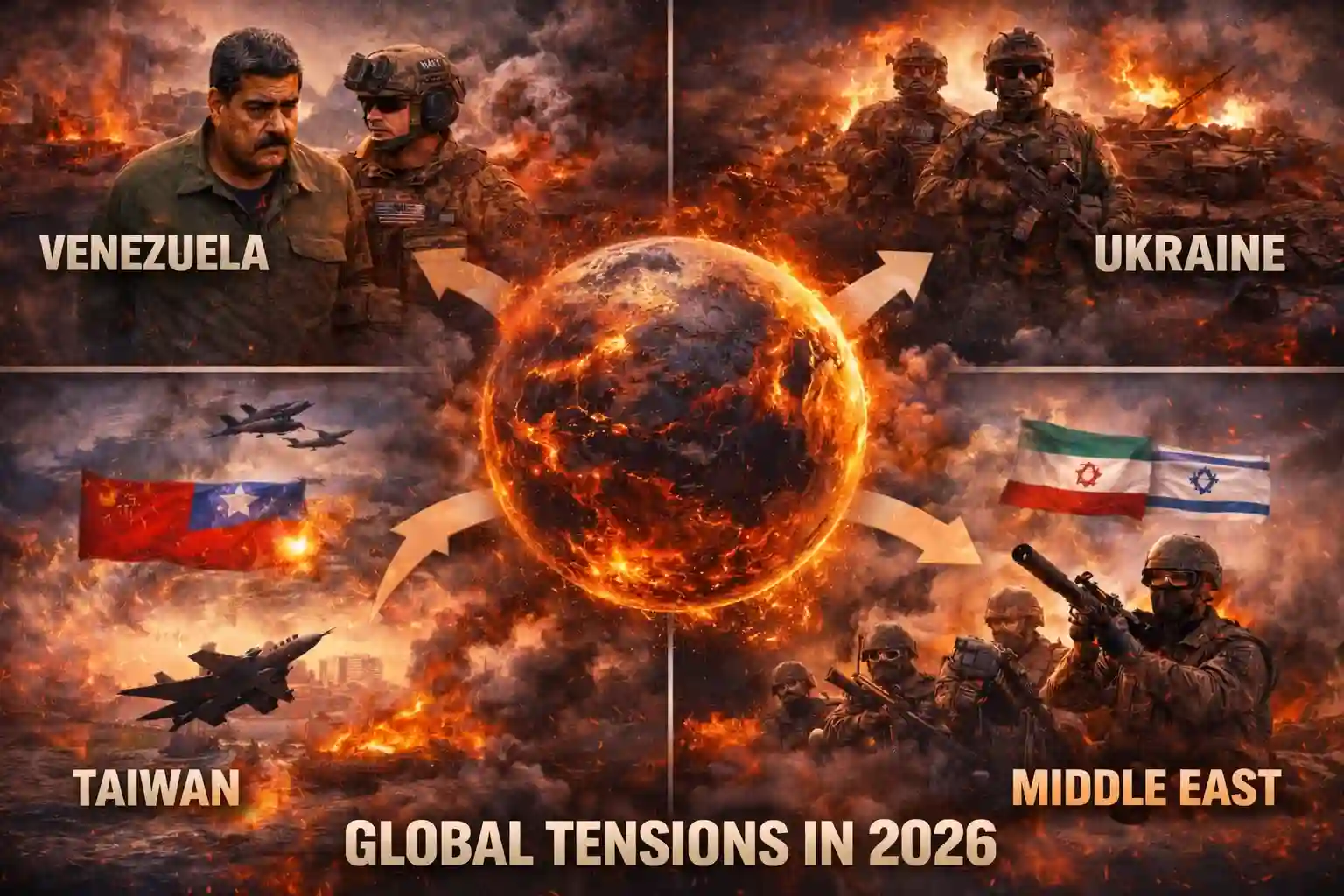

Lede: A Volatile Start to 2026
The year 2026 has opened with an unusually dense cluster of geopolitical shocks. The most dramatic is the U.S. military operation in Venezuela that captured President Nicolás Maduro, an action Washington describes as a lawful raid tied to long-standing drug trafficking indictments, and which Caracas and some allies condemn as an illegal abduction. Major wire services have documented the raid, its casualties, and Maduro’s transfer into U.S. custody (AP: what we know about the strike and its fallout; Reuters: inside the U.S. operation to capture Maduro). These events are unfolding against the backdrop of a grinding Russia–Ukraine war, renewed military signaling in East Asia, and persistent proxy conflicts in the Middle East that together are testing global markets and institutions.U.S.–Venezuela Crisis: Maduro’s Capture and Global Reaction
In the early hours of January 3, 2026, U.S. special operations forces executed a raid in Caracas that U.S. officials say neutralized security units around Maduro’s compound and led to his capture and transfer toward U.S. jurisdiction on narcotics charges. Reporting by the Associated Press and others describes dozens of casualties among Venezuelan and Cuban personnel and confirms that Maduro has appeared in a U.S. court and pleaded not guilty (AP: Trump says U.S. will take Venezuelan oil as Maduro faces charges; AP timeline: how the raid unfolded). Reuters has detailed how U.S. planners used mock-ups and intelligence support to rehearse the mission and noted subsequent airspace disruptions and flight cancellations in the wider Caribbean region (Reuters: operational details).Date of operation: January 3, 2026
Dozens reported killed among Venezuelan and allied security forces
Maduro now held in New York on U.S. drug charges
Russia’s Response and the Seizure of the Tanker Marinera
Moscow has seized on the Venezuela raid as further proof of what it calls U.S. disregard for sovereignty. The Institute for the Study of War notes that Russia’s foreign ministry issued a formal condemnation of the operation, framing it as a dangerous precedent just as Western national security advisers met in Kyiv to discuss Ukraine support (ISW: Russian Offensive Campaign Assessment, January 3, 2026). Tensions escalated further when U.S. forces intercepted and seized the Russian-flagged oil tanker Marinera in the Atlantic, which Reuters reports was suspected of carrying sanctioned Venezuelan crude. Russian officials called the action piracy and demanded the vessel’s release (Reuters: Russia says U.S. tanker seizure is illegal). Analysts warn that linking sanctions enforcement to at-sea seizures of Russian-flagged ships risks spillover into already fraught channels of dialogue over Ukraine and European security.Russian-flagged tanker Marinera seized by U.S. forces in Atlantic waters
Russia labels seizure piracy and a violation of international law
Russia–Ukraine War: Stalemate with Costly Strikes
Even as Moscow denounces U.S. actions in the Americas, the Russia–Ukraine war remains intense. Reuters reports that both sides started 2026 by accusing each other of attacks on civilians, including a Russian strike on a hotel in occupied territory and Ukrainian claims of broad Russian attacks on power infrastructure (Reuters: mutual allegations of civilian attacks over New Year). The Institute for the Study of War’s early-January assessments describe Russian forces seeking incremental advances while Ukraine prioritizes defense, long-range strikes on logistics, and efforts to secure sustained Western aid (ISW overview: Russian Offensive Campaign Assessment series). Diplomatic efforts continue, but there is no comprehensive ceasefire: Reuters notes ongoing talks involving Ukrainian and Western national security officials about land, nuclear plant safety, and long-term security guarantees rather than an imminent peace deal (Reuters: Kyiv security talks agenda).China, Taiwan, and North Korea: East Asia Reacts
In East Asia, China and North Korea are using the Venezuela episode to underscore their own narratives about U.S. power. At the same time, Beijing has just concluded its most extensive set of war games around Taiwan to date, codenamed Justice Mission 2025. Reuters reports that the drills effectively simulated a blockade with rockets, warships, and aircraft encircling the island shortly after Washington announced an $11.1 billion arms package for Taipei (Reuters: China’s war games around Taiwan; largest live-fire drills to date). Taiwan’s President Lai Ching-te has vowed to defend sovereignty and is seeking a multi-year increase in defense spending, while Taipei and its partners characterize the drills as coercive (Reuters: Lai’s New Year address).Middle East: From the Twelve-Day War to Gaza and the Red Sea
The Middle East remains volatile after the June 2025 Twelve-Day War between Israel and Iran, which International Crisis Group describes as a brief but intense conflict followed by a fragile truce that reshaped regional power balances (Crisis Group: A Twelve-Day War, A New Middle East?; plan for consolidating the ceasefire). In Gaza, a U.S.-brokered ceasefire between Israel and Hamas has largely halted the most intense fighting, but Reuters notes that Israeli airstrikes and militant attacks have continued at a lower tempo, leaving hundreds dead since the truce and keeping humanitarian conditions extremely fragile (Reuters: explainer on the Gaza ceasefire’s durability; recent airstrike in Khan Younis).Other Flashpoints: South Asia, Central Africa, and the South China Sea
Beyond headline crises, several regional conflicts continue to simmer. In South Asia, India and Pakistan endured their worst fighting in decades in May 2025, with missile and drone strikes on each other’s territory and roughly 70 people killed before U.S.-mediated talks produced a ceasefire that was violated within hours (Reuters: ceasefire and renewed fire along the border; cross-border attacks and casualties). While large-scale hostilities have eased, the episode underscores how quickly the region can lurch toward wider conflict.Global Markets and International Law Under Strain
The Venezuela crisis is already reverberating through energy and financial markets. Reuters and Bloomberg reporting shows that oil prices initially whipsawed on fears of disruption before easing as investors focused on the potential for increased Venezuelan supply if Washington follows through on plans to sell tens of millions of barrels of crude now under U.S. control (Reuters: oil prices slip despite Venezuelan turmoil; Reuters markets wrap: global markets react to Venezuela upheaval). A separate Reuters analysis notes that the capture of Maduro is the first major geopolitical shock of 2026 for investors, who are weighing the risk of escalation against the possibility that new oil flows could support risk assets over time (Reuters: Trump’s Venezuela gambit and investor risk).More from Dollars & Life
Latest News:• Shrimp Recall Expands Nationwide
• Did Venezuela President Maduro Get Captured?
• Inside the 2025 Louvre Museum Heist
Shopping & Lifestyle:
• Best Shopping Deals & Daily Discounts